
Artifact 1: Agenda for Family Safety Task Force
This artifact is an agenda for a Family Safety Task Force I created in response to parent concerns, questions, and a request for a space to mitigate risk. Although I created it outside of this course, it directly applies what I learned about family collaboration and community partnerships, and it aligns with Principal Quality Standards I, II, and IV.
The purpose of this meeting was to identify where families needed more support to ensure their students felt safe at school. We began by naming successes following safety incidents. Families cited transparent communication, both through email and through honest answers during a family meeting. Strike et al. (2019) remind us that transparent communication strengthens leadership efficacy, especially when delivered through multiple channels. This confirmed for me that using a variety of communication strategies with all stakeholders is a practice I need to sustain, not a one-time response to an incident.
As outlined in the agenda, we moved from strengths to gaps and identified outreach as the primary need. Only three parents attended this first meeting. Rather than treating that as a failure, I named it as data:confusion on date (it was published differently in two different memos) may have limited who could participate. This matters because a task force that hears only from the families who can already attend cannot represent the whole community, and that is especially true for culturally and linguistically diverse families. To broaden participation, we will add a question about what support looks like to our monthly family survey, which receives a high response rate, and also automatically translates the question into the family’s home language. This structure is designed to build family engagement and support.
We also identified a need for student education about weapons safety and for mental health support. Our solution is to work with the Home Office Culture/Mental Health and Operations teams to identify external partnerships and safety measures that can support our campus and students, which builds and sustains productive community partnerships to promote student well-being.
This artifact demonstrates growth in my ability to treat communication and outreach as a system rather than a series of responses to incidents. Early in my leadership development, I might have measured a safety response by how quickly I sent information; instead, I now see transparency as a practice that must be two-way, which means using multiple channels, answering hard questions honestly, and building structures like the task force and survey where families can tell me what they need. Low attendance at our first meeting taught me that outreach is never finished, and that the families I hear from the least are the ones I most need to reach. This reflects my developing belief that a safe school is built with its whole community, and that it is the principal’s responsibility to create the conditions, partnerships, and trust that make that collaboration possible.
Artifact 2: Module 4 Critical Thinking
This artifact is a new family orientation guide for DSST: Montview High School for the Module 4 Critical Thinking Assignment in alignment with the Principal Quality Standards I and II as well as English Learner Quality Standards 5.9 and 5.12.
For this assignment, I adjusted the existing orientation materials to better reflect the current community we have as well as the community we are hoping to build. I crafted a comprehensive, 24 page, orientation guide which has been translated into Spanish, since the majority of our language-learners are Spanish speaking. However, because the materials were created digitally, I can easily translate them into other languages represented in our community such as Amharic and Arabic.
The page below is the Table of Contents to demonstrate what topics are included in this guide as well as the translations.
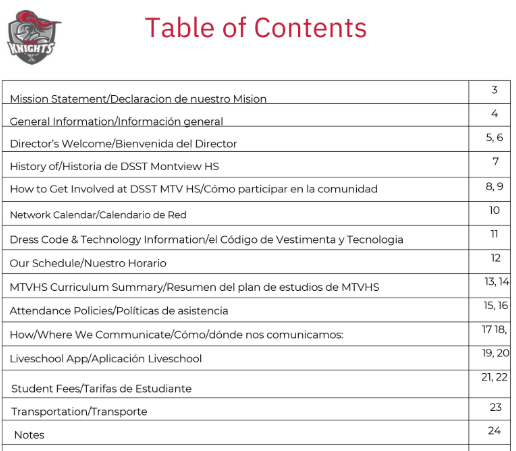
This artifact demonstrates growth in my ability to treat family communication as a system built for access. Language access has to be part of the design from the beginning. Every section, from the attendance policies to the Liveschool app and how we communicate, is presented in English and Spanish so that families are not left to decode the school on their own. Building the guide digitally also means I can extend it to Amharic, Arabic, and other languages in our community, so that outreach grows as the community does. Applying research on culturally responsive practice and funds of knowledge (Moll et al., 1992) and on equitable family engagement (Epstein, 2018) showed me that a welcoming environment is something a principal builds through concrete choices about which families are addressed, in which languages, and with what clarity. This also reflects my developing belief that transparent communication and outreach are the principal’s responsibility, and that when a school designs its first message for the families furthest from the system, it builds the trust that makes a safer, more connected school community possible.
Artifacts 3 & 4: Modules 3 & 5 Discussion
These artifacts are a reflection on why engagement with external stakeholders and community resources is essential in schools. They aligns with Principal Quality Standard IV and English Learner Quality Standards 5.9 and 5.12.
In the first discussion post and my responses to classmates, I focused on building external relationships to support multilingual families:

Many families at our school are both language learners and navigating an identified learning need, and they face a double challenge: finding their way through special education systems while also facing a language barrier. Breiseth (2021) reminds us that families are legally entitled to translation services, and not only for written materials. An IEP meeting with a translator present is far more collaborative than one without a staff member who speaks the family’s home language. Because our own staff cannot meet this need alone, I described how we combine district translation lines, translation tools such as Google Translate for written communication, and community partners. I also emphasized that translation is only part of the work. We cannot assume what has worked for a family in the past, so preferred communication methods, timing, and desired level of involvement need to be established in conversation, ideally before the school year begins, by the student’s advisor. This applies the research on culture, diversity, and equity and the strategies for supporting culturally and linguistically diverse families.
In a later discussion on community partnerships, I focused on student mental health: 
This artifact demonstrates growth in my ability to build partnerships as core infrastructure for access and well-being. Community partnerships are the way a school meets needs it cannot meet alone, especially for multilingual families, and I learned not to assume what works for any family without asking. This reflects my developing belief that the principal is responsible for seeking out, sustaining, and evaluating these partnerships so that every student benefits from the whole community around the school.
References
Breiseth, L. (2021, August). Communicating with ELL families: 10 strategies for schools. National Education Association. https://www.nea.org/professional-excellence/student-engagement/tools-tips/communicating-ell-families-10-strategies-schools
Epstein, J. L. (2018). School, family, and community partnerships: Preparing educators and improving schools (3rd ed.). Routledge.
Moll, L. C., Amanti, C., Neff, D., & González, N. (1992). Funds of knowledge for teaching: Using a qualitative approach to connect homes and classrooms. Theory Into Practice, 31(2), 132-141.
Strike, K.T., Sims, P.A., Mann, S.L., and Wilhite, R.K. (2019). Transforming professional practice: A framework for effective leadership. 2nd ed. Rowman and Littlefield.


Leave a Reply