
During my internship experiences toward earning my Colorado Principal Licensure, I have had the valuable opportunity to serve within the Central Office for a large charter network of 16 middle and high schools across the Denver Metro Area. This placement has allowed me to engage in leadership at a network level while navigating a wide variety of distinct school contexts and cultures. Then, I decided to shift roles to return to school leadership in the role of School Director (Principal) in Training at one high school where I was able to more deeply apply my thinking, particularly around innovation of systems. Engaging deeply across these diverse spaces has solidified my conviction that transformative educational leadership is grounded in the capacity of every community member (teacher, leader, student, and family) to grow, contribute, and lead. It is this exact focus on systemic capacity-building that shapes my approach to educational equity.
“Educational equity means every child, every day. Period.”
-Elena Aguilar (Coaching for Equity, p. 7)
“Educational equity means every child, every day. Period.” – Elena Aguilar (Coaching for Equity, p. 7).
If I believe that quote to be true, then as a leader it is critical I coach my team and teachers to support every single child every day no matter what, especially when it gets hard. Ultimately, my leadership vision is to cultivate a school ecosystem where shared leadership, culturally responsive practices, and high academic expectations ensure that every child, regardless of background, has access to transformative learning daily. In November and December 2025, I had the opportunity to coach AP English Literature at one of our high schools in the far northeast of Denver. At the beginning of my coaching cycle with that teacher I did a discussion map (below) and found that only 5 of 14 students spoke in a nearly 3 min discussion. 50% of the talking was done by the teacher at a Depth of Knowledge level 2.

This indicated both limited student engagement and lower cognitive demand. Using this and other observations, I developed and implemented a coaching framework focused on equity to embed within 6-week coaching cycles with 5 ELA teachers, collecting data and evidence. By focusing my coaching through the lens of equity for all students rather than just mastery of the rubric, this teacher (as well as the other 4) demonstrated more growth in six weeks than they had all year.
As I continue developing as a leader, I must consider not only how I support the school’s mission, vision, and core values in one-on-one interactions, but also how I build sustainable systems of learning. Part of this growth involves my own awareness, and part requires intentionally constructing a culture of participation, feedback, and innovation so that the school becomes a great team. As Aguilar (2016) reminds us, “We can’t do it alone. No individual alone can transform our schools into places where all children get what they need every day” (p. 7).
“It is better to broadly ‘educate’ people than simply ‘train’ them to perform particular tasks”
National Research Council (How People Learn, p. 51)
“It is better to broadly ‘educate’ people than simply ‘train’ them to perform particular tasks” – National Research Council (How People Learn, p. 51)
Continuing my success from coaching I started reflecting on our structures for coaching development and realized that what we thought was development was actually training coaches to execute specific protocols. However, we were never actually developing in coaches the ability to think critically about the teacher in front of them and respond with empathy, flexibility, and equity. Therefore, I used my internship as an opportunity to collaborate with the Human Capital team to innovate and deliver a Coaching Institute Day & 1st Semester Scope and Sequence that pivots instructional coaching toward a model of whole-person responsiveness and people management:
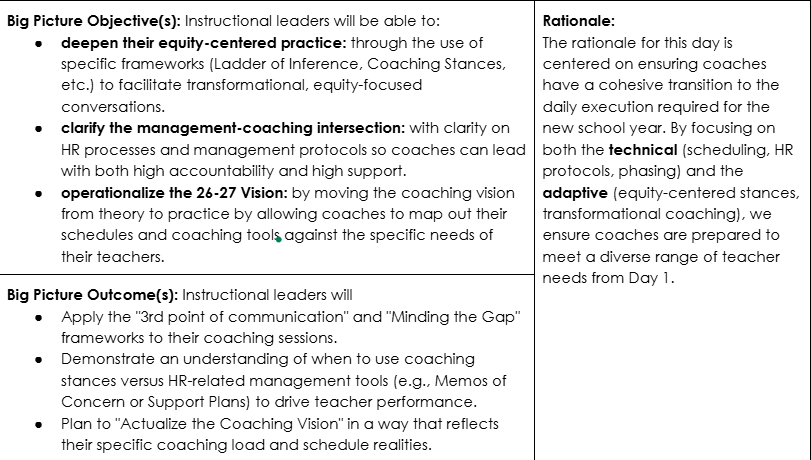
This pivot toward a model of whole-person responsiveness and strategic people management directly mirrors my learning in EDL 540: Human Resources Leadership. It reinforced that instructional leadership cannot be divorced from human capital development; we must build adult capacity rather than just monitoring compliance. I used coaching perception survey data and high-level Intent to Return trends to anchor our workshops in the genuine needs of stakeholders that are relevant, build community, and are also sustainable. This data-driven approach allowed us to foster and facilitate continual improvement by delivering practical, agnostic coaching frameworks (such as Aguilar’s (2020) Mind the Gaps Framework and her questions for the Ladder of Inference) and clear guidance on transitioning struggling teachers to support plans, effectively promoting a positive school culture that balances high support with formal evaluation measures. Finally, by keeping the coaching for equity piece front and center, this work ensured that network systems remain dedicated to unpacking implicit biases and prioritizing human-first relationships across lines of difference to “foster, advocate, attack, promote, and monitor diversity” (Strike, et al, 2019, p. 109).
The innovation didn’t just stop at the end of the Coaching Institute Day. Couros (2015) reminds us that “establishing an innovative culture doesn’t require transformation…it require[s] leaders who will develop and sustain systems…and who value the process of creating and refining ideas” (p. 20). The satisfaction rating for the day from participants averaged a 4.55 out of 5 across 4 different metrics. The qualitative data told us that: the day delivered valuable, high-impact morning tools and collaborative processing, but afternoon engagement suffered due to passive facilitation. To build on this, future meetings should replace general discussion with hands-on practice such as like role-plays and complex case studies while setting clearer norms for vulnerable topics and balancing directive frameworks. Although I have changed roles since that institute, these keys points of feedback from participants can apply to school-based professional development as well. By keeping this feedback in mind and continuing to question why for all developmental decisions I can offer innovative and transformative professional development for my school-based staff.
“School leaders envision the changes that can happen in students when the adults care”
Strike, et al. (Transforming Professional Practice, p. 114)
“School leaders envision the changes that can happen in students when the adults care” – Strike, et al (Transforming Professional Practice, p. 114)
I had the opportunity to work collaboratively in the MTSS working group. By engaging in 1:1 stakeholder meetings and contributing to the Phase 3 planning process, I served as a catalyst for shifting the group’s focus toward more equitable, student-centered policies. My contributions were instrumental in pivoting the grading policy from an accountability-based model of mandatory tutoring to one centered on positive reinforcement and retake opportunities.
I also advocated for and successfully recommended the decentralization of MTSS ownership, shifting responsibility to House Leaders (advisors) to ensure interventions are informed by a “whole-child” perspective rather than high-level data alone. This move encourages “shared leadership to form a greater sense of community ownership for all stakeholders” (Strike et al., 2019, p. 113). These efforts directly informed the development of a new MTSS Playbook—a living document that prioritizes academic excellence and instructional mastery over mere compliance.
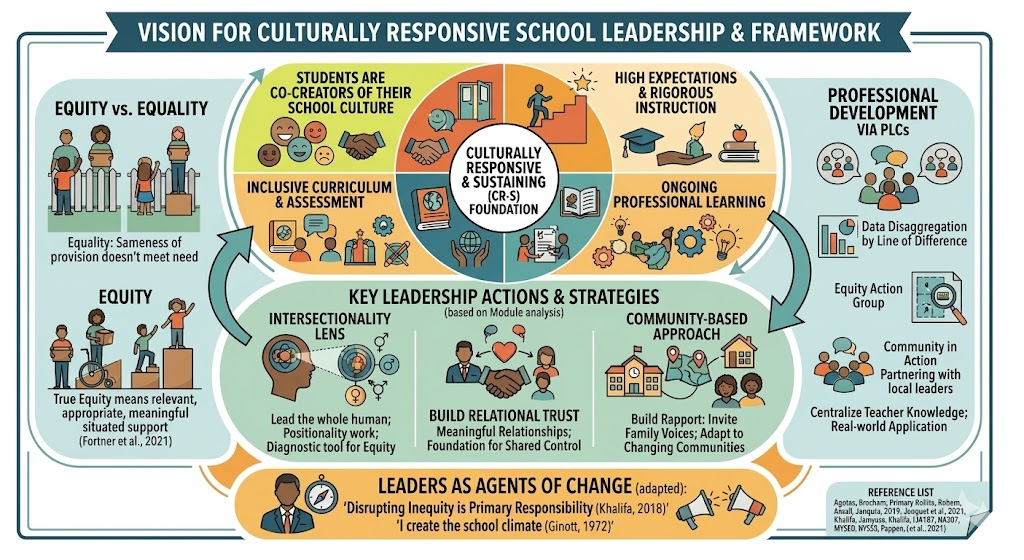
This infographic demonstrates a critical moment in my internship where I was required to move beyond restating theory and instead make visible how I believe these frameworks connect and interact in practice. In order to build a sustainable school culture and system I have to be able to answer “what if” questions to support innovation within a larger system. (Couros, 2015) Then I could synthesize complex ideas into a vision that is translatable for my community and inspires others to also invest in the school. Now that I am back in a school every day I need to continue to apply an innovative questioning process to ensure that my decisions are in alignment with the vision and also build a narrative and coalition for implementation.
“Follow your passion; it will lead you to your purpose”
Oprah Winfrey
“Follow your passion; it will lead you to your purpose” – Oprah Winfrey
Aligning my personal passion with a sustainable systemic purpose is what drove my recent career trajectory. Two years ago, I left an Assistant Principal position because I was tired of politics and being pulled in too many directions. The school was not sustainable, and it did eventually close, and that was taking a toll on me and my family. However, I knew that I wanted to stay in education because I believe so strongly that education is our country’s greatest social justice movement and so I shifted to a central office position. After two years in that role, despite the better work hours and increased flexibility, I knew that I needed to be back in a school. I needed to be with students and teachers doing the work every day in the classrooms where the learning is happening. So I decided to make the uncommon decision to shift away from the comfort of the central office back into school leadership into a School Director in Training program where I will be side-by-side with our Principal every day, effectively running the school with her. I also have the opportunity to be interim School Director while she is on parental leave. The main lesson I have learned so far is that the scope of management and vision is so much broader than I realized. It is not possible for me to know everything so it is critical to build a strong team who I can rely on and innovate with.
References:
Aguilar, E. (2020). Coaching for equity: Conversations that change practice. Jossey-Bass.
Couros, G. (2015). The innovator’s mindset: Empower learning, unleash talent, and lead a culture of creativity. Dave Burgess Consulting, Inc.
National Research Council. (2000). How people learn: Brain, mind experience, and school. Expanded edition. National Academy Press.
Strike, K.T., Sims, P.A., Mann, S.L., and Wilhite, R.K. (2019). Transforming professional practice: A framework for effective leadership. 2nd ed. Rowman and Littlefield.

