
Artifact 1: Module 1 Critical Thinking
This artifact is a reflection on the innovative use of technology for the Module 1 Critical Thinking Assignment in alignment with the Principal Quality Standards I, and II as well as English Learner Quality Standard 5.9.
This assignment asked for 5 technology-based, or digital, strategies that your school could apply today so students learn in new ways. I evaluated my school context, guidance, and the research and determined that the best way to approach this reflection and ultimate recommendations, was through a lens of systems-leadership.
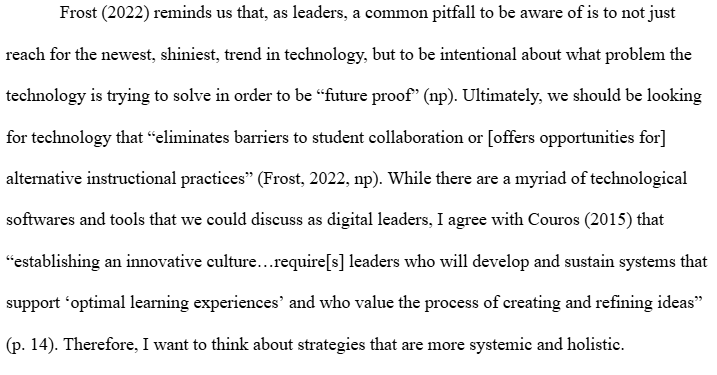
Ultimately the systems I proposed were:
- Strategy 1: Building a Culture of Digital Innovation
- Strategy 2: Tech-Enabled Professional Learning Communities
- Strategy 3: Distributed Leadership: Digital Innovation Committees & Peer-Led Curation
- Strategy 4: Intentional Technology-First Evaluation Frameworks
- Strategy 5: Multimodal & Collaborative Learning Structures for MLL Students
These 5 strategies build upon each other to create a vision and structure for a culture of innovation through a clear lens on instructional leadership and ultimately focused on our Multi-lingual Learners and Students with Disabilities who often lack the most access to technology. If we don’t start with building the culture of digital innovation teachers, and students, will lack the psychological safety and culture of trust to innovate (Jin & Peng, 2024). If the staff does not have this foundation then the rest of the innovations won’t matter because they will only live in small pockets or not ever take off the ground at all. If we are innovating to support all students, especially the ones who need us the most, then we cannot let this happen.
This artifact demonstrates growth in my ability to move beyond individual technology tools and into systems-level thinking as required by Principal Quality Standards I and II. Early in my leadership development, I might have evaluated these five strategies in isolation; instead, I sequenced them so that culture-building comes first and instructional innovation follows, because I now understand that structures without trust rarely take hold. This reflects my developing belief that equity-driven technology leadership means designing for the students who are furthest from opportunity first, not layering support onto a system built for the majority.
Artifact 2: Module 3 Critical Thinking
This artifact is a family and community presentation on the creation of an Elementary School budget in the 27J School District in Brighton, Colorado for the Module 3 Critical Thinking Assignment in alignment with the Principal Quality Standards I and III as well as English Learner Quality Standard 5.9.
For this assignment, I interviewed an elementary school administrator about how their school budget is created and then put together a 9 slide presentation to synthesize the information with the purpose of building and intentional community, enhancing capacity and understanding of the families/community, aligning systems of communication, and demonstrating how the budget is allocated to support the whole child, and most specifically, how we support our sub groups (Language Learners, SpEd, Gifted & Talented, etc.) financially.
The slide below is the final “Key Takeaways” slide with the speaker notes that bring together all of the critical information for families while highlighting the necessity of working collaboratively to support student success:
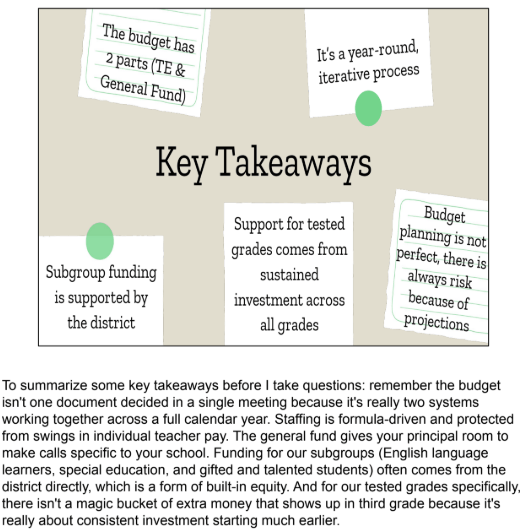
This artifact matters because it demonstrates my growth in translating complex financial systems into something families and communities can actually use, a core piece of Principal Quality Standard III. Building this presentation pushed me to think not just about what the budget contains, but about how transparency itself builds trust between a school and the families it serves. I now see that community-based leadership requires this kind of translation work constantly: taking systems that are often opaque by default and making them legible enough that families can be genuine partners rather than passive recipients of decisions made on their behalf.
Artifact 3: Module 5 Discussion
This artifact is a reflection on the implementation of Restorative Justice practices in a school as a facilitator for strengthening school culture. This is for the Module 5 class discussion in alignment with the Principal Quality Standards II and III.
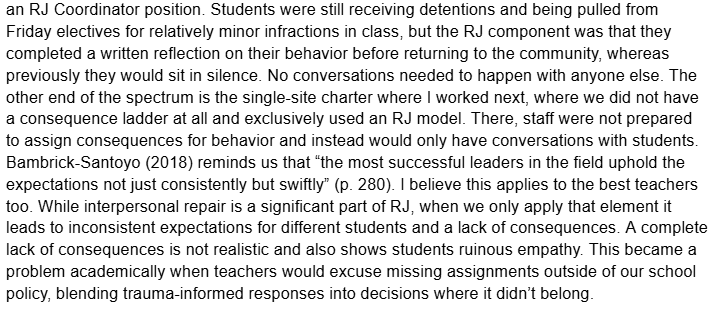
In this discussion post, and my responses to my classmates, I highlighted the importance of mindset coaching for staff to ensure that Restorative Justice practices don’t become an alternate to consequences where staff then lower the bar of expectations for student academics and behavior. This was my personal experience when a Restorative Justice model was rolled out at a previous charter network in 2016 and again in a different school in 2020:
As a school leader in a school now which incorporates elements of Restorative Justice into our behavior management model, I find that it is critical to ask myself some questions:
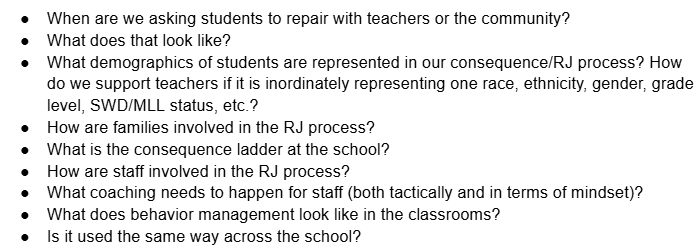
This reflection demonstrates growth in my thinking about Restorative Justice from something I once implemented procedurally to something I now interrogate structurally, in line with Principal Quality Standards II and III. Drawing on my own experience across two very different RJ rollouts taught me that culture and consequences are not opposites; a school can hold both high expectations and genuine repair if leaders are intentional about the system, not just the philosophy. The questions I raise here reflect my belief that culturally responsive discipline requires leaders to keep auditing who the system serves, rather than assuming good intentions are enough.
References
Bambrick-Santoyo, P. (2018). Leverage leadership 2.0: A practical guide to building exceptional schools. Jossey-Bass.
Couros, G. (2015). The innovator’s mindset: Empower learning, unleash talent, and lead a culture of creativity. Dave Bourgeois Consulting.
Frost, A. (2022). 4 K-12 tech trends to follow in 2023. EdTech. https://edtechmagazine.com/k12/article/2022/12/4-k-12-tech-trends-follow-2023
Jin, H., & Peng, Y. (2024). The impact of team psychological safety on employee innovative performance: A study with communication behavior as a mediator variable. PLoS ONE,


Leave a comment