
Artifact 1: Module 6 Critical Thinking
This artifact is a professional growth plan for a high school English teacher following a classroom observation for the Module 6 Critical Thinking Assignment in alignment with the Evaluator Training Standards I, II, III, IV, and V. Based on my observation of the teacher, she was clearly committed to equitable access for all students suggesting an intentional approach to meet the needs of diverse learners and demonstrating strength in Quality Standard II: Element C (CDE, n.d.). She also had students strategically working in pairs and so demonstrated strength in Quality Standard III: Element E (CDE, n.d.). However, a key area for development was High Leverage Feedback (Quality III: Elements B & D (CDE, n.d.). Therefore I chose to create a growth plan for her based around that:
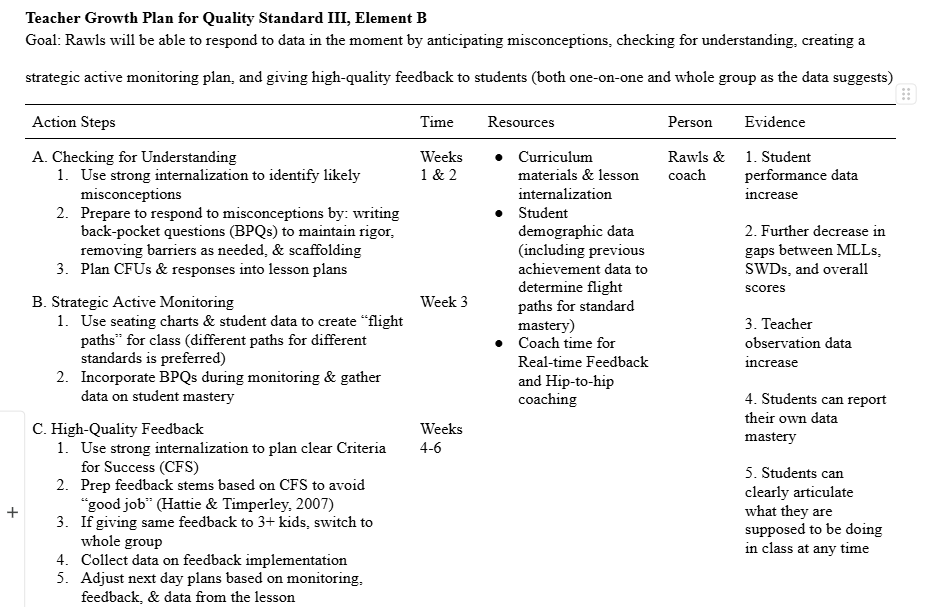
This growth plan represents my comprehensive understanding of the evaluation cycle because it breaks out the goals for the teacher in multiple steps as well as considers the specific evaluation cycle, methodologies, and resources that we already have in place at our school (such as one-on-one coaching, real-time feedback, and hip-to-hip monitoring) that are also a match for this teacher’s learning style. The steps are also differentiated based on observed need and capitalizes on the teacher’s strengths as well.
The true evolution in my understanding through this artifact was not in how to draft a growth plan, but in uncovering my own blind spots regarding observational bias. In this assignment, I also reflected on where I might have experienced bias in my observation and through this determined future action steps such as low-inference notes to mitigate bias, leadership calibration training, and asking another leader to join me in observation if I feel I might have a bias in an upcoming observation (Xu & Stronge, n.d.). Recognizing that my seasoned perspective could still be subject to bias forced me to shift from relying on holistic impressions to implementing strict, low-inference data collection and seeking peer calibration. This represents a significant shift from an autonomous coach to a self-reflective, objective evaluator.
Artifact 2: Collaborative Planning with the Human Capital Team
These artifacts are from my internship project where I had the opportunity to collaborate with the Human Capital Team to build deeper understanding for that team on instructional coaching at our network and then create a scope and sequence for development on human-centered evaluation practices. This work is in alignment with Evaluator Training Standards I, II, III, IV, and V.
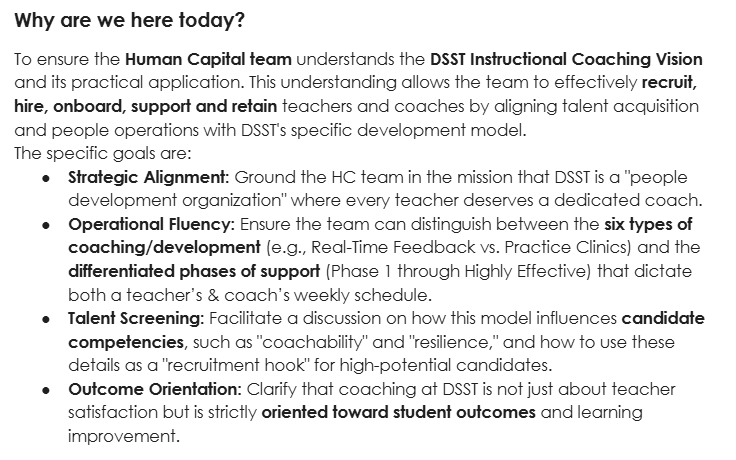
The first opportunity for collaboration was for the Human Capital team to understand the DSST Coaching Vision and its practical application to differentiated development of staff so that they can recruit, hire, onboard, support, and retain people. This also had a direct impact on the evaluation system as following this meeting a revision process began to better align the system to what the realities of coaching actually are at DSST. Starting next year, there will be a specific pathway of support for evaluators tied to the instructional coaching vision: if a teacher is in Phase 1 of development (an unmanaged classroom) for more than six weeks they will shift to a support plan, followed by a professional improvement plan if needed. Prior to this, the Human Capital team was unaware of what teachers were being evaluated on or how they were being supported and so the criteria for a support plan in coaching was vague and therefore coaches did not know when to use them.
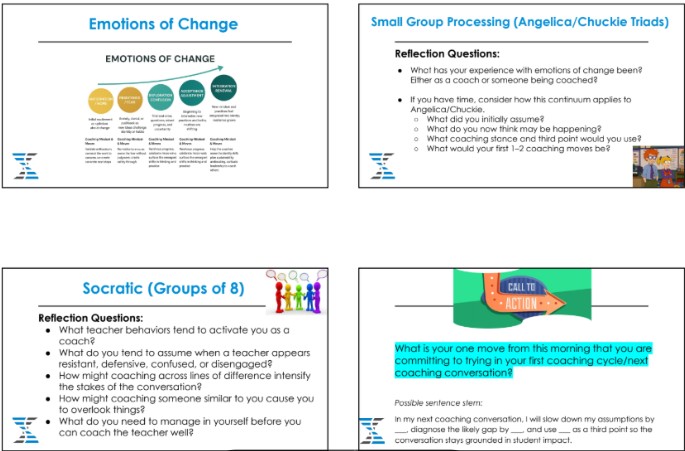
After this meeting, I was then able to work with the Human Capital team to create a full day Coach Institute which focuses on whole-person coaching and culturally responsive coaching centered on the theories and frameworks from Elena Aguilar’s book Coaching for Equity. The purpose of this day is to support coaches (who are evaluators at the school level) in understanding the connections between evaluations and growth, but more importantly, how to identify and recognize biases in themselves and others and coach around those mindsets. These biases can range from race-related mindsets (which usually manifest as confirmation biases) to stereotyping and the recency effect. The four slides above are from the end of the morning session which will ask coaches to synthesize what they have learned and also incorporates a call to action. Finally, the Human Capital team will be leading a session that is specifically around high accountability & high support to bridge all of the gaps and create a cohesive picture of coaching to support all teachers whether they are struggling or excelling.
These artifacts are important because they represent my growth from understanding how the evaluation process works for myself (as evidenced by artifact 1) to creating a system for how to enact a sustainable and fair evaluation process as a systems-level leader. This balcony view of understanding will be critical as I continue my leadership.
References:
Aguilar, E. (2020). Coaching for equity: Conversations that change practice. Jossey-Bass.
Colorado Department of Education [CDE]. (n.d.). Rubric for evaluating Colorado teachers. https://www.cde.state.co.us/educatoreffectiveness/revised-teacher-rubric
Xu, X. & Stronge, J. (n.d.) 5 Tips to understanding and avoiding bias in teacher performance evaluations.Frontlineeducation. https://www.frontlineeducation.com/blog/avoid-bias-in-teacher-performance-evaluations/
 Sarah Boxer’s Principal Portfolio
Leave a comment