
Leadership Dispositions #6: To promote each student’s academic success and well-being, effective educational leaders develop the professional capacity of school personnel.
This course centers on the critical human resource functions of a school leader to create a functioning, inclusive, effective, and healthy learning environment for the entire community. This is critical for all staff, and so I focused specifically on the development of instructional leaders through my internship because one of a leader’s “top priorities should be to find, hire, and develop leaders” (Strike, et al, 2019, p. 163). My network had a strong focus on finding and hiring these leaders but our development was myopically focused on the leadership role rather than what it means to be a leader and coach holistically. This meant that our leadership teams were ill-prepared to address learner achievement gaps or hold teachers accountable in coaching.
My Leadership Goal: I knew that in order to create a more holistic space for professional development for leaders I needed to work closely with our Human Capital team to build a stronger foundation of understanding before I could engage in job-embedded professional learning. Therefore I set the goal to collaborate with the Human Capital team to deliver a Coaching Institute Day & 1st Semester Scope and Sequence that pivots instructional coaching toward a model of whole-person responsiveness and people management. The final deliverable will be a structured training roadmap ready for leadership review.

Summary of Achievements
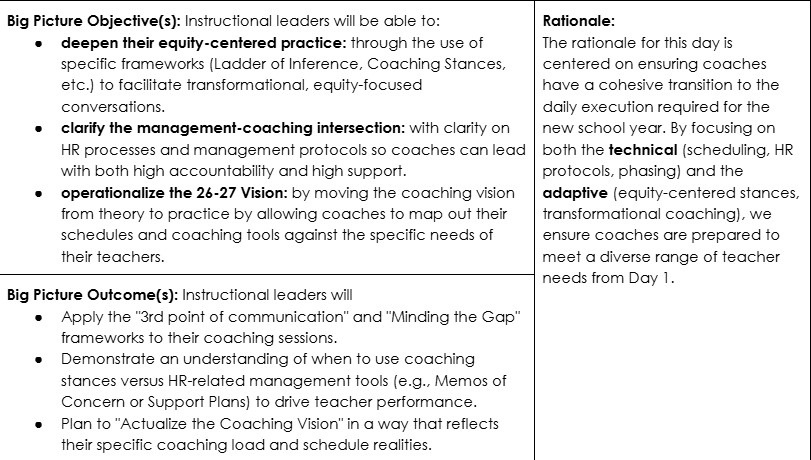
During this cycle, I focused on creating a system that would develop the professional capacity of school leaders to ultimately promote each student’s academic success and well-being. By collaborating directly with the Human Capital team, I successfully met my leadership goal.
I used coaching perception survey data and high-level Intent to Return trends to anchor our workshops in the genuine needs of stakeholders that are relevant, build community, and are also sustainable (Strike, et al, 2019). This data-driven approach allowed us to foster and facilitate continual improvement by delivering practical, agnostic coaching frameworks (such as Aguilar’s (2020) Mind the Gaps Framework and her questions for the Ladder of Inference)) and clear guidance on transitioning struggling teachers to support plans, effectively promoting a positive school culture that balances high support with formal evaluation measures. Finally, by keeping the coaching for equity piece front and center, this work ensured that network systems remain dedicated to unpacking implicit biases and prioritizing human-first relationships across lines of difference to “foster, advocate, attack, promote, and monitor diversity” (Strike, et al, 2019, p. 109).
Opportunities for Growth & Reflection
While the primary deliverables were successfully completed, because time constraints at the final Assistant School Director/School Director meeting prevented us from reviewing the agenda collectively, I realized I needed to more effectively determine when feedback was necessary versus optional and from whom and then ensure effective communication around that need (Strike, et al, 2019).
Additionally, there is a clear opportunity to more deeply promote a positive school culture and facilitate continual improvement by explicitly integrating specific Culturally Responsive Coaching Models into an upcoming Instructional Leadership Day or Instructional Leadership Team structures rather than leaving them as broad concepts.
“Shifting from a compliance-driven management style to a collaborative, goal-setting partnership with educators is a prerequisite for systemic stability and school culture.”
Evolution of Understanding
True educational leadership requires building adult capacity through an equity lens. If we do not explicitly anchor our instructional coaching in DEI principles and look at lines of difference, data-driven instructional interventions will ultimately break down. Furthermore, shifting from a compliance-driven management style to a collaborative, goal-setting partnership with educators is a prerequisite for systemic stability; when school personnel are empowered to co-create goals with their evaluators, it directly drives staff retention and strengthens the school culture. While this is a belief that I have held for a long time, my understanding has evolved from viewing this development as something that should be done one-on-one to development that is urgent and important for the whole staff. Therefore it was critical to push for the shift in the Scope & Sequence of leadership development. Strike, et al. (2019) reminds us that “we must discard the idea that it’s dangerous to express vulnerability…continual improvement calls for reflection, open and honest communication, and the opportunity to participate in ongoing dialogue” (p. 51). As a leader, it is my responsibility to create the conditions such that people feel comfortable engaging in this dialogue so that these conversations are possible. Without them, our leaders will not grow as quickly, and students deserve more.
Fostering Future Competency
To continue building professional capacity and aligning our operational practices with culturally responsive leadership, I am committed to the following actions:
- Talent Acquisition Alignment: I will partner with the talent acquisition team to build an “Ideal Candidate Profile” for upcoming hiring cycles that explicitly evaluates candidates against whole-human coaching mindsets and culturally responsive coaching indicators.
- Integration of Equity Tools: I will continue to collaborate with leadership to weave targeted equity and self-reflection questions directly into our practical daily tools, such as the IP checklist, ensuring culturally responsive practices are operationalized rather than theoretical.
- Operationalized Leadership Support: I will continue refining the boundaries between coaching development and formal evaluation, ensuring coaches are thoroughly equipped to navigate difficult management conversations with high support and high accountability since “the differences between leaders and managers should be acknowledged and their responsibilities in the workplace should be aligned accordingly” (Strike, et al, 2019, p. 140).
References:
Aguilar, E. (2020). Coaching for equity: Conversations that change practice. Jossey-Bass.
Strike, K.T., Sims, P.A., Mann, S.L., and Wilhite, R.K. (2019). Transforming profession practice: A framework for effective leadership. 2nd ed. Rowman and Littlefield.


Leave a Reply