
Artifact 1: Module 3 Critical Thinking
This artifact is a reflection on the exclusionary practices at my school network and recommendations to shift to more inclusive practices for the Module Three Critical Thinking Assignment, aligning with Principal Quality Standards II, II, and IV as well as English Learner Quality Standards 5.9 and 5.10.
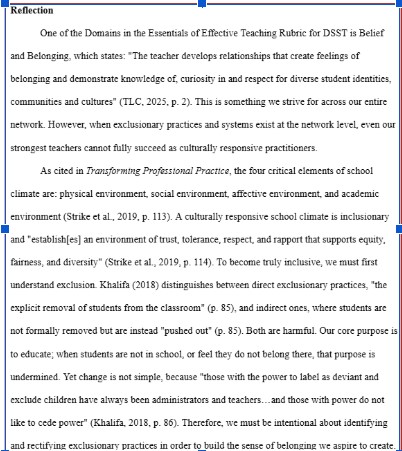
This reflection represents my developing understanding of culturally responsive leadership at the network level, not just the classroom or school level. The artifact matters because it reflects my ability to look at the bigger picture of the school system/network and demonstrates my growth in understanding that culturally responsive leadership requires the examination of those systems, rather than focusing on individual mindsets. Khalifa (2018) directs us to consider specific exclusionary practices such as removing students from class. In this artifact, I make three recommendations to demonstrate my understanding of the necessity for genuine collaboration with staff, students, families, and communities to implement true culturally responsive inclusion: collaborative assessments, a community-based LiveSchool model, and sustained academic rigor for all learners.
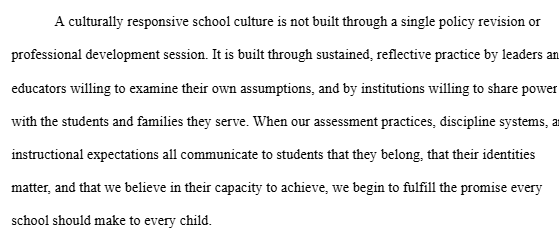
Ultimately, this reflection demonstrates growth in my understanding of how important it is to create equitable learning conditions and a culturally responsive school environment for all stakeholders because without that people are not going to want to show-up. I do this through offering three specific, and actionable, solutions to shift exclusive practices into inclusionary ones. As the conclusion to my reflection (above image) indicates, this is built through a sustained system of reflection, revision, and inclusive practice to create a sense of belonging for all students and families.
ARTIFACT 2: Module 7 discussion posts
These two discussion posts represent my developing thinking on intersectionality as a leadership framework, not just a theoretical concept and align with Principal Quality Standard IV and English Learner Quality Standard 5.9
The first post:
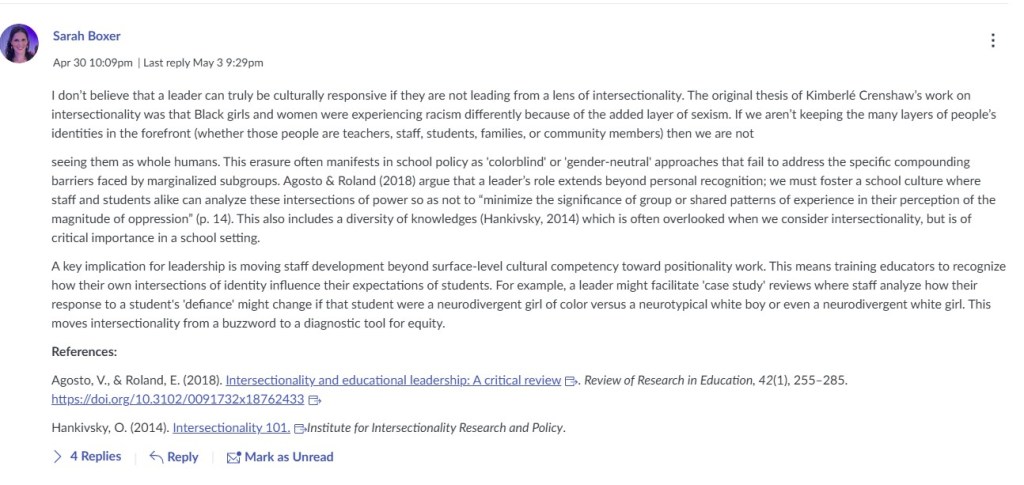
argues that culturally responsive leadership is inseparable from an intersectional lens, drawing on Kimberlé Crenshaw’s original definition of intersectionality (race and gender) as well as more recent research from Agosto and Roland (2018) on a school leader’s role and Hankivsky (2014) about how intersectionality conversations need to include the student’s diversity as a learner as well. I bring these ideas together to connect intersectionality to concrete school policy and staff development practice. The second post, a response to Dr. Wellner:
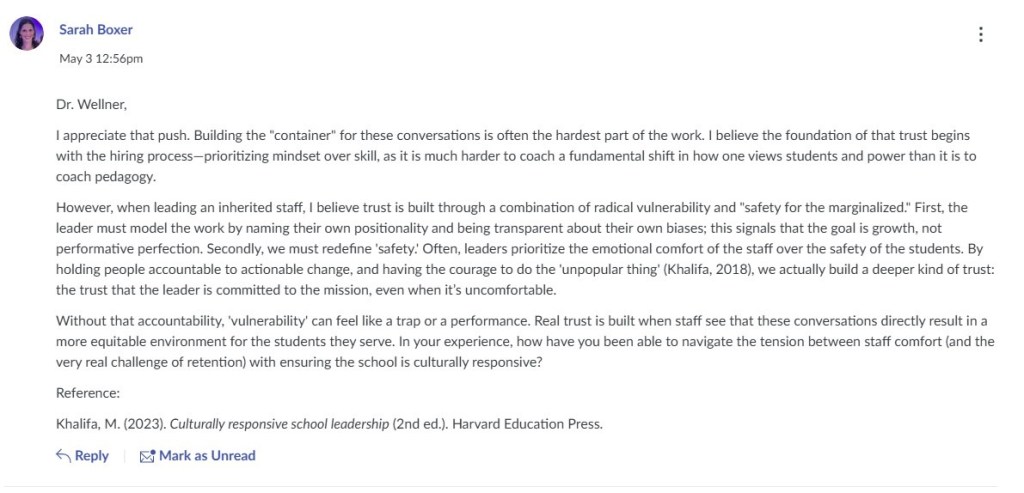
pushes further to answer the practical question of how leaders build the trust necessary to do this work with an “inherited staff.”
This artifact matters because these discussion posts demonstrate my growth from being able to not only name a problem, but to now also proposing practical solutions from the lens of school leadership using intersectionality not just as a buzzword but as a diagnostic tool for equity. In both my initial post and my response I consider real issues leaders face with questions of staff bias and I confront those tensions with honesty, authenticity, and open acknowledgement of the complexities. However, I do not back away from the necessity of holding staff, or myself, to building trust and having difficult conversations through vulnerability in order to reach a culturally responsive and equitable school culture for all. Specifically, I believe that it is the critical work of a school leader to move their staff toward positionality work through self-reflection and case study discussions during staff development.
Artifact 3: Infographic (For Module 8 Discussion)
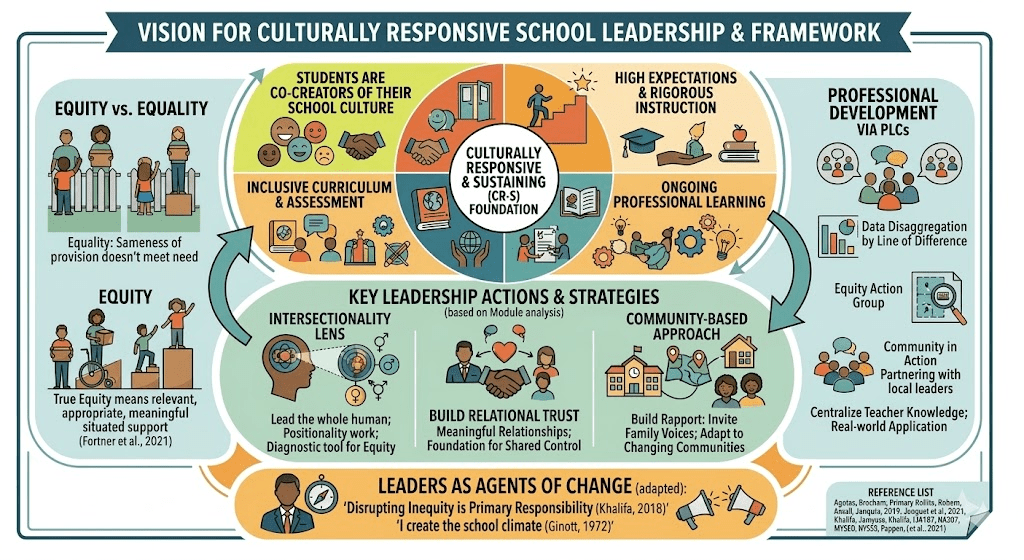
This infographic was created to represent my synthesized vision for culturally responsive school leadership and grounded in course research. It aligns with Principal Quality Standard II and English Learner Quality Standard 5.9
This infographic is important because it required me to move beyond restating theory and instead make visible how I believe these frameworks connect and interact in practice. As a leader I am grounded in two key ideas: the disrupting inequity is the leaders primary responsibility (Khalifa, 2018) & leaders create the weather (Ginott, 1972). The infographic captures the full arc of my thinking: from the foundational distinction between equity and equality on the left side, through the Culturally Responsive-Sustaining (CR-S) framework (New York State Education Department, n.d.) as an organizing structure, to the specific leadership action and strategies (including professional development for staff) that will make all of this happen. It also reflects a deliberate choice to use AI tools (Notebook LM and Gemini) as thought partners in the design process to synthesize my narrative into visual format. This models the kind of innovative, resource-aware leadership that I believe is necessary for future-facing schools.
This artifact reflects my ability to synthesize complex ideas into a leadership vision that is, literally, visual and translatable. The infographic demonstrates that equity and equality are not interchangeable, that leaders and change agents and the work needs to be a sustaining cycle in order for the framework to truly be culturally responsive, and that all staff/stakeholders need to be involved in the learning. It reflects my growth in understanding that culturally responsive leadership is not an add-on to the work of running a school; it is the work.
Artifact 4: Co-created plan for MTSS
This artifact represents a concrete product I co-developed during my Culture and Equity internship as part of the Multi-Tiered Student Services (MTSS) Initiative Working Group for network implementation and aligns with Principal Quality Standard I as well as English Learner Quality Standard 5.10.
Over six weeks, I collaborated with school and network leaders to identify gaps in two key academic systems (reassessment practices and MTSS ownership structures) and developed actionable recommendations for each. The Instructional Leadership Team (ILT) Guidance Scope and Sequence document emerged from that process as a practical tool designed to help instructional leaders use data purposefully and consistently across grade levels. It reflects both my ability to engage in systems-level reform and my commitment to ensuring that instructional leadership structures are equitable, responsive, and grounded in whole-child knowledge.
This artifact demonstrates growth in my ability to move from identifying a problem to building the infrastructure needed to address it. Going into this internship, I understood that MTSS effectiveness depends on clear ownership and consistent data use. What this experience pushed me to develop was the practical knowledge of how to design those structures in a way that is both rigorous and culturally responsive. The ILT Guidance Scope and Sequence is not just a planning document; it is an attempt to codify a shared vision of instructional excellence with the consideration of all of the different roles and responsibilities that leaders hold in a school.
The work was genuinely collaborative. I met with central office leaders, school administrations, culture team members, and garnered feedback in working group sessions. Because of this collaboration, the resulting product is truly reflective of the realities of the leaders in the schools as well as the needs of the MTSS initiative team. Together the ILT Scope and Sequence I co-developed operationalizes a shared vision of instructional excellence by establishing a tiered data rhythm, weekly, bi-weekly, monthly, and quarterly, with clear ownership at each level. This clarifies who owns which data, what questions each cadence should answer, and what thresholds should trigger action rather than leaving data use to chance. This level of detail was necessary because the MTSS initiative for next year is new for many of our schools and we have a large number of new leaders and coaches who are unfamiliar with data-driven coaching/teaching. Therefore, this reflects my understanding that sustainable change requires not just vision but the structural accountability to support it.
Finally, the ILT Guidance document is explicitly designed to build the capacity of instructional leaders to use data effectively, not just collect it, which is a trap we fall into often. The document offers multiple tools and protocols to help leaders create a school-based common vision of instructional excellence and develop shared language for what good coaching and intervention look like starting from the network expectation. This allows each school to reach higher, but never start from below our baseline expectations of what we know students/staff are capable of. Embedding these protocols into a scope and sequence ensures the work is sustainable and not dependent on any one person holding the knowledge.
The work also surfaced important tensions I am still sitting with as a network-leader: how do we build systems that are consistent enough to be equitable without becoming so top-down that they lose responsiveness to individual schools and communities? That question shaped many of the recommendations I brought to the working group (such as determinations for who owns which data sets) and continues to inform my thinking as a leader.
References:
Agosto, V., & Roland, E. (2018). Intersectionality and educational leadership: A critical review. Review of Research in Education, 42(1), 255–285. https://doi.org/10.3102/0091732×18762433
Ginott, H. G. (1972). Teacher and child: A book for parents and teachers. Macmillan Company.
Hankivsky, O. (2014). Intersectionality 101.Institute for Intersectionality Research and Policy.
Khalifa, M.A. (2018). Culturally responsive school leadership. Harvard Education Press.
New York State Education Department. (n.d.). Culturally responsive-sustaining education framework. NYSED.gov.
Strike, K.T., Sims, P.A., Mann, S.L., & Wilhite, R.K. (2019). Transforming professional practice: A framework for effective leadership. 2nd ed. Rowman & Littlefield.
Wiggins, G. & McTighe, J. (2005). Understanding by design. 2nd ed. ASCD.
 Sarah Boxer’s Principal Portfolio
Leave a comment