
Leadership Dispositions #3 & 5: Promoting Culturally Responsive Teaching Practices in an Inclusive School Culture
This course centers on what it means to be a culturally responsive school leader. As such, it is critical to consider not only one’s own development but also the development of the staff in collaboration with the school community through transformational leadership “in which school leaders envision the changes that can happen in students when the adults care” (Strike et al., 2019, p. 114). Furthermore, a culturally responsive school culture is inclusive by design, which means it takes active refinement and readjustment in response to data to maintain as student populations, cultural contexts, and communities change.

Initial Plan Creation
Throughout this course, I focused on building a stronger connection between the school culture team and the academic development team as we move forward with a network-wide initiative for Multi-Tiered Student Support (MTSS). Initially, the MTSS initiative was being led by the school culture team without consultation from the academic development team and was, therefore, missing critical components regarding the teaching practices necessary for implementation. Strike et al. (2019) highlight in Leadership Component 3a that:
“effective leaders provide training, scaffolding, and support for staff to implement an initiative successfully…[putting] the monitoring of student progress at the heart of decision making” (p. 38).
My Leadership Goal: I aimed to actively contribute to the MTSS working group by identifying and clarifying at least two key student-centered academic systems that currently impact school culture and co-develop concrete recommendations for each. I planned to gather input from at least three stakeholders to refine these proposals, culminating in a clear, actionable plan with defined success criteria.
Summary of Achievements
During this six-week collaborative cycle, I acted as a high-leverage contributor to the MTSS working group. By engaging in 1:1 stakeholder meetings and contributing to the Phase 3 planning process, I served as a catalyst for shifting the group’s focus toward more equitable, student-centered policies. My contributions were instrumental in pivoting the grading policy from an accountability-based model of mandatory tutoring to one centered on positive reinforcement and retake opportunities.
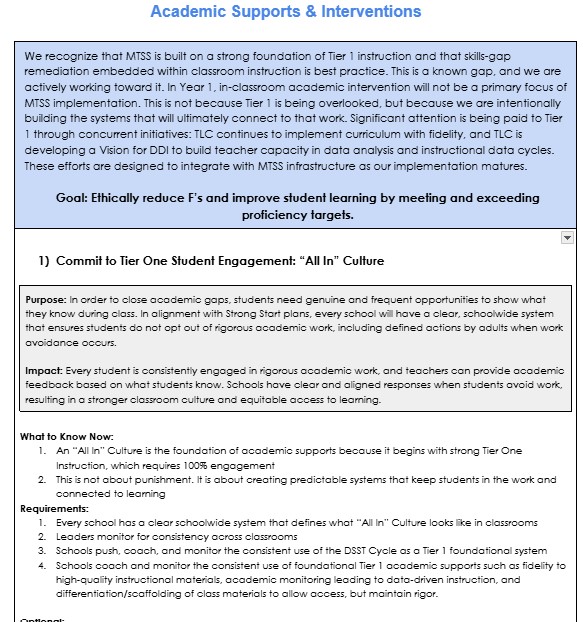
I also advocated for and successfully recommended the decentralization of MTSS ownership, shifting responsibility to House Leaders (advisors) to ensure interventions are informed by a “whole-child” perspective rather than high-level data alone. This move encourages “shared leadership to form a greater sense of community ownership for all stakeholders” (Strike et al., 2019, p. 113). These efforts directly informed the development of the MTSS Playbook, a living document that prioritizes academic excellence and instructional mastery over mere compliance.
Opportunities for Growth & Reflection
While I met my initial goals, the process highlighted strategic pivots necessary for future work. I observed a notable divergence in how Middle and High School leaders received these systems, revealing a need for differentiated leadership support. Moving forward, I must ensure network-wide initiatives are translated to meet the unique cultural and operational pressures of each school tier. Additionally, I recognized that our “runway for change” was too short. Providing a clear, early framework is an act of culturally responsive leadership; it respects the “cognitive load” of teachers in Title 1 schools and allows for the intentional adaptation of practices rather than rushed implementation.
As Khalifa (2018) notes, maintaining high expectations for minoritized students is a critical component of culturally responsive leadership. To meet this standard, we must move beyond measuring “100% engagement” and instead define excellence through student collaboration and grade-level mastery. We must also interrogate the “trickle-down” effects of our requirements to ensure that inclusivity remains a sustainable practice for both students and staff.
Evolution of Understanding
My understanding of these dispositions has shifted from viewing inclusivity as a series of individual teacher actions to recognizing that systemic infrastructure is a prerequisite for equity. If foundational systems—such as grading or MTSS—are rooted in compliance, even well-intentioned teaching practices will struggle to take root. As Khalifa (2018) argues, a leader must go beyond personal advocacy to actively reform the institutionalized policies that hinder student success.
Furthermore, I have moved from a model of “stakeholder consultation” to a belief in community co-design. I now understand that true culturally responsive leadership requires involving families and students at the architectural stage of a project to ensure the design truly reflects the community it serves.
Fostering Future Competency
To continue fostering competency in these dispositions, I am committed to:
- Strategic Transparency and Lead-Time: I will advocate for earlier transparency in initiative rollouts. This aligns with the leadership mandate to create “supportive environments that promote the health and well-being of all school personnel” (Strike et al., 2019, p. 147).
- Dynamic Feedback Loops: I will facilitate the ongoing iteration of the MTSS Playbook by establishing true two-way feedback loops within collaborative team meetings. This ensures our leadership decisions remain grounded in the lived realities and “whole-child” needs of our school community.
References:
Khalifa, M. (2018). Culturally responsive school leadership. Harvard Education Press.
Strike, K.T., Sims, P.A., Mann, S.L., and Wilhite, R.K. (2019). Transforming profession practice: A framework for effective leadership. 2nd ed. Rowman and Littlefield.


Leave a Reply