
Artifact 1: Module Two Critical Thinking Assignment
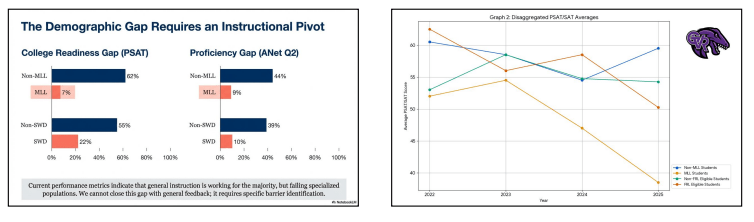
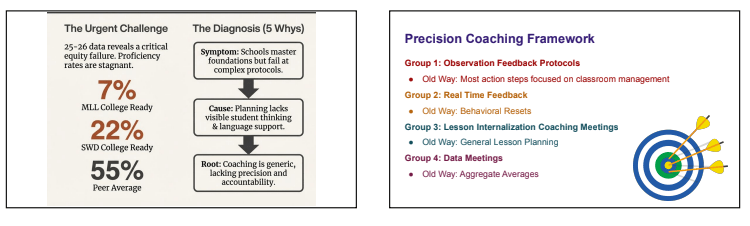
This artifact is a set of slides excerpted from my presentation to the Instructional Task Force for the Module Two Critical Thinking Assignment, aligning with Principal Quality Standards II and III as well as English Learner Quality Standards 5.10, 5.11, and 5.12.
The artifact matters because it captures a pivotal decision point for our school. It demonstrates a clear understanding of how to analyze data holistically, disaggregate it to pinpoint the highest-leverage gaps, and conduct root cause analysis in order to close those gaps and better support all learners, particularly MLLs and SWDs. The data disaggregation showed that general instruction is working for the majority of our students, but the gap between MLL/Non-MLL and SWD/Non-SWD students is very wide at both the middle and high school levels. Research cited in the Colorado READ Act (2025) tells us that students who cannot read proficiently by the end of third grade are four times more likely to drop out of high school, making early intervention crucial for preventing later academic failure. While not all of our MLL and SWD students have a READ Plan, many of them do, and regardless, a significant number are performing well below grade level as defined by the Colorado READ Act (three or more years below grade level).
What this artifact represents is a shift in how I approach systemic problem-solving as an instructional leader. My initial instinct was to respond to the data by adjusting classroom instruction directly. My team and I conducted a root cause analysis process together. Through this process, we determined that adjusting our approach to instructional coaching would have a larger impact. It would result in more systemic impact on student growth. This conclusion was supported by research from Kraft, Blazar, and Hogan (2018). They found that teachers who received effective coaching improved their instructional practice by about half a standard deviation. This is a large effect in education research. Their students gained nearly one-fifth of a standard deviation, the equivalent of several additional months of learning.
The growth I experienced through this process was in learning to follow the data past the first obvious solution. The Instructional Task Force collaborated with us. We identified small, targeted shifts in our coaching protocols. These shifts would better support MLLs and SWDs across the building. That systemic lens focuses on coaching structures and not just individual classrooms. It represents a meaningful change in how I understand instructional leadership. It also changes my perception of my own role in it.
Artifact 2: Module 4 Critical Thinking
This artifact is excerpts from the Module 4 Critical Thinking Assignment in which I responded to a case study about a teacher who is beginning to integrate technology into his classroom and wants to deepen that integration. This assignment aligns to Principal Quality Standards I and III as well as English Learner Quality Standards 5.9 and 5.12.
The artifact matters because it captures how I think about leading instructional change in a way that is both strategic and humane. Rather than simply recommending a list of tools, I built a technology integration plan for Mr. Brown that was intentionally designed around the instructional habits he already had.

This is where cognitive load theory shaped my thinking most directly. Cognitive load theory refers to the amount of information our working memory can process at any given time and helps us avoid overloading learners with more than they can effectively process into schemas for long-term memory storage and future recall (Medical College of Wisconsin Office of Educational Improvement, 2022). In other words, while Mr. Brown and his students are building new routines around technology, the surrounding structures should stay familiar. They should remain stable to ensure the cognitive lift of change is minimal.
Alongside the technology integration plan, I identified specific supports and scaffolding to serve Mr. Brown’s MLL students, connecting the new tools to the research, theories, and strategies available for that population.

Over time I would like to see Mr. Brown move toward language forms that are content-agnostic. These forms are more transferable across contexts. However, in keeping with cognitive load principles, that development can come later. This should happen once the technology routines are established.
This artifact represents my understanding that sustainable instructional change is about both mindset and tools. The development plan I created for Mr. Brown reflects this. While it does include training on specific technologies, it focuses more on building skills and dispositions. These will serve Mr. Brown and his colleagues long after any particular platform becomes obsolete. To that end, I recommended pedagogical frameworks. I also suggested establishing strong procedures and routines for technology use. These foundations transfer in ways that tool-specific training simply does not.
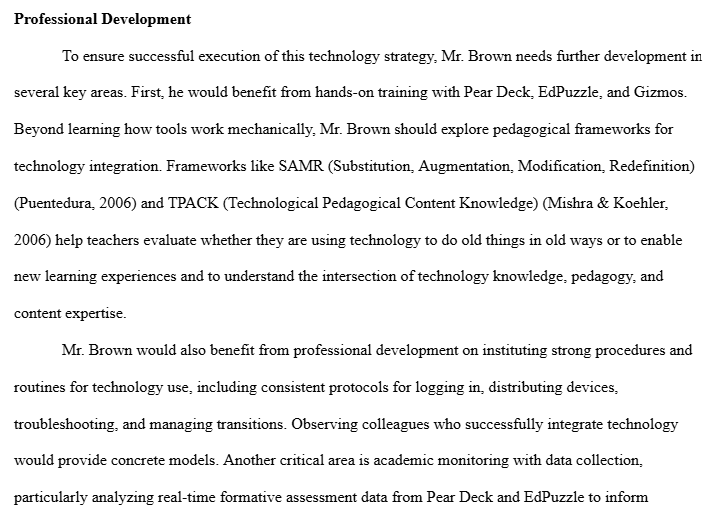
The growth I experienced through this assignment was in how I understand my role as an instructional leader when it comes to technology. I came into this course thinking about technology integration primarily as a logistical challenge. What I leave with is a much clearer sense that the leader’s job is to reduce friction, protect teacher confidence during transitions, and build toward transferable skills rather than one-time compliance with a new tool. Cognitive load theory gave me a framework. I now apply it not just to student learning. It also applies to adult learning and professional development.
Artifact 3: ILD Presentation on MLLs/SWDs in Coaching
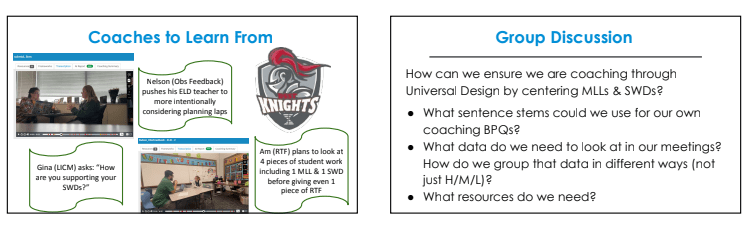
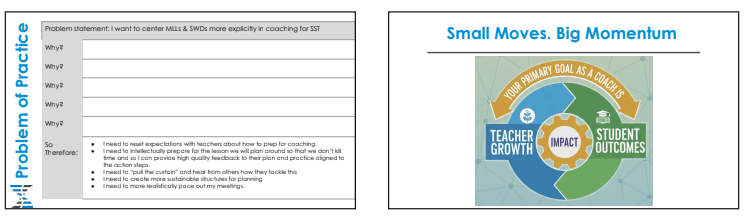
This artifact is a set of slides excerpted from my presentation to all of the Instructional Leaders in the Denver Schools of Science and Technology Charter Network, aligning with Principal Quality Standard I and English Learner Quality Standards 5.10 and 5.11.
The artifact matters because it is not a course assignment. It is evidence of what happened when the learning from this program moved directly into my practice. The root cause analysis shown in Artifact 1 revealed needs beyond my own school. A development opportunity arose in front of roughly 80 instructional leaders across the network. I deliberately chose to use it. That choice is a demonstration of strategic leadership. It involves taking a real platform and redirecting it toward the needs of MLL and SWD students. This was instead of defaulting to the planned agenda.
What this artifact represents is the reach of that decision. During the session, I had instructional leaders discuss what strategies they could use to center these student populations in their coaching work. I offered specific examples of coaches from around the network who were already doing this well. We then moved directly into individual root cause analysis before stepping into action planning, so the conversation had an immediate application rather than remaining theoretical.
The growth captured here is in how I understand the difference between awareness and action at scale. Before engaging with data in this way, our network practice would have been to move immediately into small group cohorts without pausing for a full-group conversation about disaggregation. Making space for that conversation, and framing it around coaching rather than teaching, was a shift in how I think about what a professional development session can do. It is one thing to understand equitable access theory. It is another to structure a room of 80 leaders around applying it, and this artifact shows that I am doing both.
Artifact 4: Module 8 Discussion
| Professional Learning Plan for Calibration Goal: To ensure that instructional leaders across the network are calibrated on the observation look-for tool | ||||
| Action Steps | Time | Resources | People | Evidence |
| 1. Ensure the Home Office curriculum & development team is calibrated → Accepts invitation to be a member of the calibration team → Attends calibration training | March 2026 – August 2026 | Network observation walk-through tool & classroom look fors Norming guidance for the look fors Allocate time for HO leader training Allocate time for instructional leader trainer (ideally during a pre-existing ILT meeting) Classroom videos of look fors for differentiated follow-up development Allocate time for follow-up walks | Network President VPs of TLC, Leader Dev, & Academic Program Directors & Senior Managers of TLC & Leader Dev Managing Directors | 1. All calibration team members are within 1 point of each other in scoring |
| 2. Ensure network calibration → Home Office calibration team sets up calibration walks with all instructional team members at each school (anyone who would be observing and rating a teacher) →Development and reflection on the rubric to ensure alignment on look-for vocabulary →Classroom walks/observations → Scoring discussions | School Directors School Directors in Training Assistant School Directors Coaches Deans Teacher Leaders | 2. All instructional leaders are within 1 point of the HO leader in scoring 3. Instructional leaders can determine the highest leverage next steps for teachers based on the observations (including action steps & phases of development for differentiated coaching) | ||
| 3. Follow up with leaders who were not calibrated → Small group development on specific uncalibrated rows → Repeat the calibration process above | August 2026 – Sept 2026 | |||
This artifact is my professional learning plan for both network leaders and school instructional leaders, built around the goal of calibrating our classroom walkthrough tool and look-fors across the network. It aligns with Principal Quality Standard II and English Learner Quality Standard 5.9.
The artifact matters because calibration is the foundation that everything else rests on. Instructional leaders must be calibrated to the same bar of excellence. Without this alignment, coaching toward that bar is impossible. The students who lose the most in that gap are the ones who can least afford inconsistency. This includes our Students with Disabilities and our Multi-Lingual Learners. Our look-fors are grounded in research on equitable access. We focus on Academic Monitoring, Structured Student Talk, and the consistent implementation of accommodations. Getting leaders aligned on what those look like in practice is not a procedural task, it is an equity imperative.
What this artifact represents is systems thinking applied over time and across two cycles of root cause analysis. I first identified a need around MLL instruction. My root cause analysis pointed to a lack of precision in coaching. I built a professional learning plan, executed it, and measured the results. Structured student talk proficiency grew from 15% to 27%. This was real progress. However, it fell short of what I had anticipated. Rather than accepting that result and moving on, I went back to the root cause analysis and looked deeper. What I found was that the underlying gap was not in coaching moves alone. The issue was whether our instructional leaders were calibrated to the same standard in the first place. You cannot coach with precision toward a bar that different observers are measuring differently.
The growth this artifact captures is in how I understand the relationship between data, action, and iteration. The first root cause analysis made me a better coach. The second one made me a better systems thinker. I am now proposing we begin this calibration work immediately. We should carry it into next year. This is a sustainable plan because our look-fors will remain consistent. That decision reflects a shift in how I see my role. I see myself less as someone who responds to gaps. I view my role more as someone who builds the conditions that prevent them.
References:
Colorado Department of Education. (2025). 2025 READ Act. https://www.cde.state.co.us/coloradoliteracy/2025readact
Kraft, M. A., Blazar, D., & Hogan, D. (2018). The effect of teacher coaching on instruction and achievement: A meta-analysis of the causal evidence. Review of Educational Research, 88(4), 547–588. https://doi.org/10.3102/0034654318759268
Medical College of Wisconsin Office of Educational Improvement. (2022). Cognitive load theory: A guide to applying cognitive load theory to your teaching (Faculty Quick Guide). Medical College of Wisconsin. https://www.mcw.edu/-/media/MCW/Education/Academic-Affairs/OEI/Faculty-Quick-Guides/Cognitive-Load-Theory.pdf
 Sarah Boxer’s Principal Portfolio
Leave a comment