
Leadership Dispositions #4 & #10: Promoting Academic Success With Intellectually Rigorous Systems and Data-Driven Improvements
This course centered on driving instructional practices in my network through a data-driven approach to ensure that ALL students can succeed. During these eight weeks I was reminded how important it is to consider the systems-level approach to leadership. Strike, et al. (2019) reminds us that “leaders acknowledge, encourage, redirect, teach, model, and build capacity in others” (p. 55). Most specifically, I focused on acknowledging and building capacity in others to drive a major initiative across the network.
Using coaching, teacher, and student data, my goal was to support the increase in structured student talk in classrooms through targeted coaching shifts and professional development.
Initial Data Collection and Plan Development
Network-wide data demonstrated discrepancies in proficiency on standardized tests. Our Multi-Lingual (MLL) and Students with Disabilities (SWD) were not achieving at nearly the same rate as their general education peers. The differential for MLLs was 45% average and for SWDs was 31.5% average on our January ANET (MS)/Practice SAT (HS).
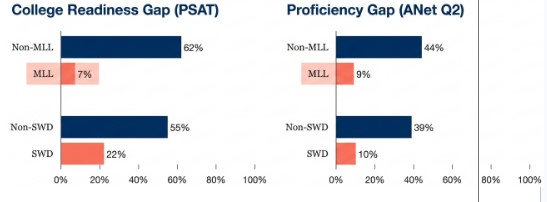
Furthermore, coaching data from the beginning of January demonstrated a major gap. Coaches were not attending to equity in their meetings with teachers. This was true regardless of whether it was a lesson internalization, data, or observation feedback meeting. There was a disconnect between student data trends and coaching conversations. This became the entry point for my work.
I know that “communication is absolutely essential to effective leadership” (Strike, et al., 2019, p. 58) and so I had to consider very carefully how I was going to present this information to leaders, because I also wanted to ensure that they were just as motivated as I was by this data. Furthermore, “The Leadership Framework 1b proposes that effective school leaders build shared leadership” (Strike, et al., 2019, p. 112). I applied Knowles’ principles of andragogy to create and communicate shared leadership. I developed a plan for all network coaches. This included presenting the data as a problem to be solved. Coaches had choices in how to approach coaching with their own root cause analysis. They were provided with a variety of example solutions and small group discussion opportunities. This was followed by immediate application in planning.
Successes and Outcomes
Throughout these eight weeks, several successes emerged. Most notably, teacher proficiency increased from 15% to 37% in Foundations of Student Voice and to 26% in the implementation of Structured Student Talk Routines in classrooms. This growth matters. As Cisneros (2018) notes, “the Science of Reading has brought evidence-based instruction to the forefront.” It also underscores the need for English Learners to receive focused oral language development. This is because “oracy is foundational to effective communication” (np). Structured student talk protocols are not simply a general engagement strategy. They are crucial for building the oral language skills that drive literacy outcomes for MLL and SWD populations specifically. Furthermore, coaches reported an increase in confidence with having student-academic equity focused conversations in their coaching meetings, which represents a meaningful shift in coaching culture across the network.
Areas of Opportunity
Strike, et al. (2019) reminds us that “leaders see change as an opportunity for growth” (p. 80), and this process illustrated that directly. In the middle of implementation, I realized something important. The goal I had started with was increasing structured student talk in classrooms. However, it was not the correct goal. I needed to make a shift. Being able “to continually monitor, evaluate, and modify the school…learning plans” (Strike, et al., 2019, p. 32) is an important aspect of being a leader, and this was a moment where that skill was put to the test. By working with one of our schools, I noticed a key issue; another leader and I observed different things in the same classroom. I began to question how calibrated we are as network leaders regarding teacher evaluation. If we are not calibrated, it calls into question the validity of our data. Ultimately, it impacts the quality of support we are providing to students.
This realization points directly to a gap in my own leadership practice. If we are truly calibrated, we are working toward the actual purpose of structured student talk in the classroom. We are teaching language in a targeted way that serves SWDs and MLLs. If we are not calibrated, we risk implementing a strategy aimed only at general engagement. This approach doesn’t move the needle for the students who need it most.
Evolution of Understanding
This work deepened my understanding of systems-level leadership. It pushed me to consider not just what it means to think through instructional leadership as a coach. It also made me think about what it means to lead instruction across an entire system. In particular, I am left thinking about calibration. What does that look like not just in individual classrooms? It also needs to work across a school and network in order to support equitable teaching practices for all students. What does it mean for a school to be calibrated when it comes to culture mindsets or stances on restorative justice? What does it mean to be calibrated on what is or is not racially biased practice in teaching? Khalifa (2018) argues that culturally responsive school leaders must critically self-reflect. They must create spaces where staff can do the same. This suggests that calibration is not only a technical process but also a values-driven one. If “we must reject micromanagement and make open communication common practice” (Strike, et al., 2019, p. 58), then we must also trust that the feedback and data being collected by other leaders in our system is valid and accurate. Calibration is a critical step toward building that trust, and it is a step I initially missed.
Going forward, I am committed to designing structured calibration experiences. These experiences will be for myself, network coaches, and school leaders. They will be grounded in both instructional evidence and our shared equity commitments. This includes norming on what effective structured student talk looks like for MLL and SWD students specifically. This is important so that the data we collect reflects what is actually happening for kids. It should not reflect what we each individually interpret to be true.
References:
Cisneros, D. (2024). Oracy for Multilingual Learners. Curriculumassociates.com. https://www.curriculumassociates.com/blog/multilingual-learners
Khalifa, M. A. (2018). Culturally responsive school leadership. Harvard Education Press
Knowles, M. S. (1984). The adult learner: A neglected species (3rd ed.). Gulf Publishing
Strike, K.T., Sims, P.A., Mann, S.L., and Wilhite, R.K. (2019). Transforming profession practice: A framework for effective leadership. 2nd ed. Rowman and Littlefield.
 Sarah Boxer’s Principal Portfolio
Leave a comment