
Leadership Disposition #1: Modeling Core Principles Through Transformational Leadership
This course centered on modeling the school’s core principles, mission, vision, and values, in all aspects of leadership. While my network’s six core values (respect, integrity, courage, curiosity, doing your best, and equity) guide our work, Strike et al. (2019) remind us to ask: “How will this help our students excel as learners? This is the true mission of the school community” (p. 106).
Observational data revealed that not all students at my internship placement school were receiving the equitable education they deserved. Therefore, I oriented myself in transformational leadership through curriculum and instruction, recognizing that “effective educational leaders develop and support rigorous and coherent systems of curriculum, instruction, and assessment to promote each student’s academic success and well-being” (Strike et al., 2019, p. 110). I determined that intensive, collaborative coaching would be my most effective approach, as collective teacher efficacy is one of the highest-impact predictors of student learning, particularly for students historically underserved by traditional schooling systems (Hattie, 2012). As Hattie (2012) notes, “Teachers need to see themselves as change agents…Their role is to change students from what they are to…what we want them to know and understand – and this, of course, highlights the moral purposes of education” (p. 184). The curriculum analysis, data examination, and belief-action conversations that occur through coaching-heavy approaches (Killion, 2008) build the collective efficacy teachers need to embrace their identity as change agents. By strengthening these instructional conditions, we create pathways through which all students can become proficient readers, directly advancing DSST’s mission to eliminate educational inequity.
My goal was to increase equitable instructional practices among ELA teachers at my internship site by intentionally embedding DEI-focused coaching practices into regular lesson-internalization and data coaching meetings.
Initial Data Collection and Framework Development
I began by gathering baseline observational data on equitable classroom practices, particularly around access to rigorous materials and student voice. The discussion map below illustrates this initial data:
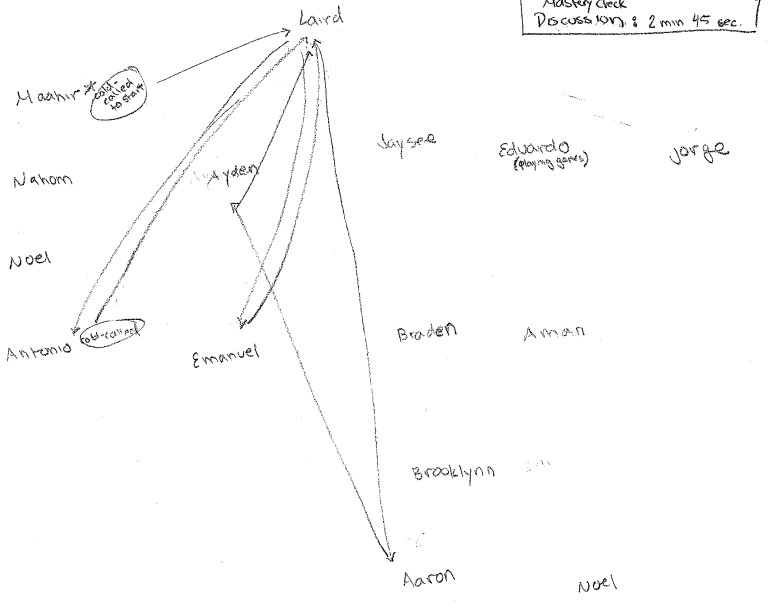
This discussion map from an AP English Literature classroom shows that only 5 of 14 students spoke, with 50% of the talking done by the teacher at a Depth of Knowledge level 2. This indicated both limited student engagement and lower cognitive demand. Using this and other observations, I developed and implemented a DEI coaching framework to embed within 6-week coaching cycles with 5 ELA teachers, collecting data and evidence as an ongoing part of our coaching conversations.
Successes and Outcomes
Over six weeks, several significant successes emerged. Most notably, through data-driven coaching centered on discussion mapping, I supported teachers in increasing student engagement from 3% to 82%, far exceeding my initial goal. Teachers accomplished this by incorporating structured student talk routines and encouraging peer-to-peer discussion habits rather than centering teacher talk in class.
Recent classroom walkthroughs showed that 100% of classrooms had evidence of at least one appropriate scaffold to support all learners. Previously, teachers either over-scaffolded or provided no scaffolds at all. By establishing a consistent coaching cycle with all 5 teachers that included lesson internalization, I supported teachers in intentionally considering potential barriers and misconceptions for students and planning for them in advance.
Additionally, through unit internalization and consideration of disaggregated data, 3 teachers expressed feeling more confident about how to appropriately scaffold their upcoming unit after winter break.
Areas of Opportunity
However, success in individual coaching cycles does not yet equal sustainable systemic change. While I focused effectively on curriculum, instruction, and assessment in these classrooms, teachers and leaders have identified time and sustainability as barriers. I have supported teachers through coaching but have not yet created systemic structures to build long-term change.
Moving forward, I am considering several approaches:
- Content-agnostic training for leaders situated in transfer of skills and specific student-centered outcomes so that leaders can better collaborate with each other
- Empowering teachers to make data-driven instructional decisions for their classrooms even when co-planning (e.g., if data indicates that students need a mini-lesson on a specific topic, teachers should make those changes regardless of who planned the lesson)
- Streamlining research-backed trainings into micro-learning sessions
Evolution of Understanding
This work has deepened my understanding of the Leadership Disposition. Initially, I viewed modeling core principles solely through academic outcomes in classrooms. Now I recognize that embodying our mission and values requires building sustainable systems that create “an environment that exhibits trust, tolerance, respect, and rapport” (Strike et al., 2019, p. 62) for both staff and students.
As I continue developing as a leader, I must consider not only how I support the school’s mission, vision, and core values in one-on-one interactions, but also how I build sustainable systems of learning. Part of this growth involves my own awareness, and part requires intentionally constructing a culture of participation and feedback so that the school becomes a great team. As Aguilar (2016) reminds us, “We can’t do it alone. No individual alone can transform our schools into places where all children get what they need every day” (p. 7).
Moving forward, I recognize the need to shift from a coach-centered model to a distributed leadership model where all staff become change agents responsible for continuous improvement in their own and colleagues’ practice. Even if I embody the school’s mission, vision, and core values in my coaching, I need to develop systems that model those same principles, systems like collaborative PLC structures, streamlined professional development protocols including differentiated micro-learning, and empowered teacher decision-making frameworks, so we can all advance our mission together.
References:
Aguilar, E. (2016). The art of coaching teams: Building resilient communities that transform schools. Jossey-Bass
Hattie, J. (2012). Visible learning for teachers: Maximizing impact on learning. Routledge
Killion, J. (2008). Are you coaching heavy or light? National Staff Development Council, 29(2), 1-4.
Strike, K.T., Sims, P.A., Mann, S.L., and Wilhite, R.K. (2019). Transforming profession practice: A framework for effective leadership. 2nd ed. Rowman and Littlefield.
 Sarah Boxer’s Principal Portfolio
Leave a comment