
The above artifact is my analysis from the Module One discussion board in which I examined our school network’s commitment to diversity, equity, and inclusion (DEI) through the language of our vision and mission statements, aligning with Principal Quality Standards I (Strategic Vision and Continuous Improvement) and II (Instructional Leadership), as well as Educational Leadership Standard 5.9 (Creating Equitable and Inclusive Learning Environments). This artifact is important because it represents a critical examination of the alignment—or misalignment—between our stated values and our instructional vision. While our network’s mission statement and commitment to equity articulate DEI values clearly, my analysis revealed that these values are less explicitly embedded in our instructional vision, which is significant because instructional vision directly shapes classroom practices and student experiences. This artifact demonstrates growth in my understanding of how leadership language shapes organizational culture and practice. Initially, I might have assumed that a strong mission statement was sufficient to drive equitable outcomes; however, this analysis revealed that equity must be intentionally woven into all aspects of school operations, particularly instructional vision, to create meaningful change. As Bambrick-Santoyo (2018) emphasizes, effective leaders must build “replicable systems and structures” (p. 5) that translate vision into action. My recognition of the gap between our equity mission and instructional vision allowed me to focus my leadership efforts on developing the systems needed to support teachers in creating truly inclusive classroom environments. To ensure continuous improvement toward this vision, I established quarterly review cycles to assess how instructional practices reflect our equity commitments. This shift in understanding, from viewing DEI as a statement to seeing it as an operational imperative requiring structural support, demonstrates my development as an instructional leader capable of bridging the gap between aspirational values and daily practice.
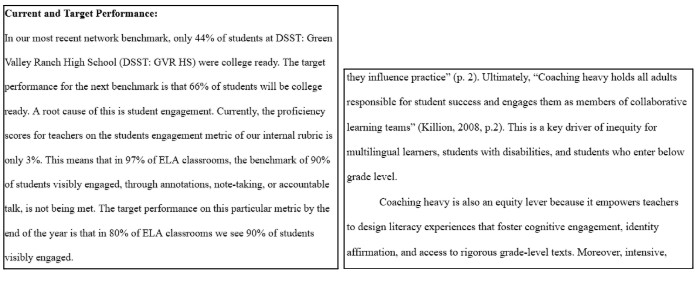
The artifact is an excerpt from my strategic planning document from the critical thinking assignment in module two, which asked us to identify and define the central issue we would be tackling in our strategic plan. I identified instructional coaching as the key lever to address the equity gap in our instructional vision, which aligns with Principal Quality Standards I (Strategic Vision and Continuous Improvement), III (Management for Learning), EL 5.9 (Creating Equitable and Inclusive Learning Environments), and EL 5.12 (Using Data to Drive Improvement). This artifact is important because it represents the translation of our mission and vision into actionable strategy by identifying where to focus leadership efforts to create meaningful change. As Strike et al. (2019) remind us, “Leaders acknowledge, encourage, redirect, teach, model, and build capacity in others” (p. 55), and this artifact demonstrates my commitment to building teacher capacity in alignment with our equity goals. Through progress monitoring, I identified data indicating that only 3% of ELA classrooms had students who were visibly engaged, revealing a critical skill gap rather than a will gap among our already-committed teachers. This artifact provides evidence of my growth in using data to drive instructional decision-making and in recognizing that equity issues often require targeted capacity-building rather than broad mandates. My decision to engage in “coaching heavy” (Killion, 2008) support specifically in ELA classrooms demonstrates a shift from general professional development approaches to strategic, data-driven interventions. This evolution in my leadership practice, from identifying gaps to strategically deploying resources to address them, shows my development in connecting vision to implementation through systematic instructional improvement strategies.
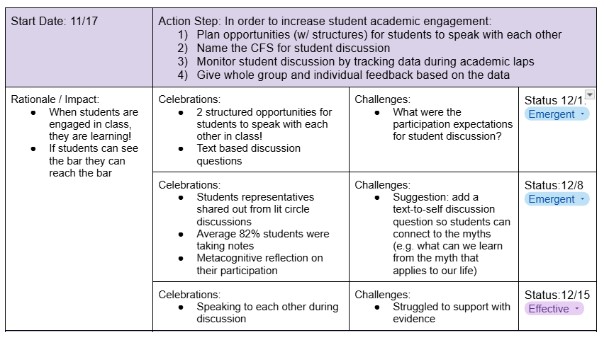
The artifact is an action step from one of my coaching trackers for a teacher with a high percentage of multilingual learners (MLLs) in her AP English Literature class who had not engaged them effectively in discussion, aligning with Principal Quality Standards II (Instructional Leadership), III (Management for Learning), EL 5.9 (Creating Equitable and Inclusive Learning Environments), and EL 5.12 (Using Data to Drive Improvement). This artifact is important because it represents the practical application of data-driven coaching to address equity gaps in classroom practice, specifically ensuring that multilingual learners have meaningful access to rigorous academic discourse. As Bambrick-Santoyo (2018) reminds us, data-driven coaching is essential to school improvement and should be the first step in any improvement plan. This artifact demonstrates my growth in implementing systematic coaching cycles that use data to identify problems, set targeted action steps, and monitor progress toward equity-focused goals. Initial observation data revealed that during a three-minute class discussion, only 5 of 14 students spoke, and 50% of the talking was done by the teacher at a Depth of Knowledge level 2, indicating both limited student engagement and lower cognitive demand. Through the first three weeks of the six-week coaching cycle, I progress-monitored this action step, and after the teacher demonstrated mastery, we shifted focus to building structured student talk routines into the curriculum to further support all learners. This progression illustrates my development as an instructional leader who can use iterative coaching processes to move teachers from basic engagement strategies to more sophisticated, equity-centered instructional practices that ensure all students, particularly multilingual learners, have access to high-level academic discourse.
References:
Bambrick-Santoyo, P. (2018). Leverage leadership 2.0: A practical guide to building exceptional schools. Jossey-Bass.
DSST. (2025, June). About Us. DSST Public Schools. https://www.dsstpublicschools.org/about-us
Killion, J. (2008). Are you coaching heavy or light? National Staff Development Council, 29(2), 1-4.
Strike, K.T., Sims, P.A., Mann, S.L., and Wilhite, R.K. (2019). Transforming profession practice: A framework for effective leadership. 2nd ed. Rowman and Littlefield.
Teaching, Learning, and Curriculum. (2025, May). DSST instructional vision. Denver [Internal Report]. DSST Public Schools
 Sarah Boxer’s Principal Portfolio
Leave a comment